Fly Me to the Saitama
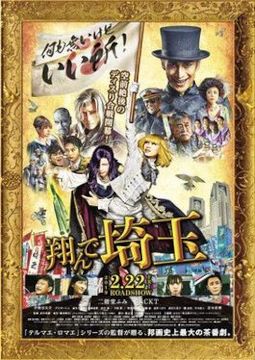
I think everything Japanese I've ever seen has been weird in some way. To me, the Japanese are the masters of weird. And I feel that's mostly a good thing.
Fly Me to the Saitama (翔んで埼玉), from 2019, is definitely one of the weirdest things I've seen in a long time. In the film, Japan is a dystopian society where Saitamites are oppressed, stripped of their rights, and forced to carry permits to enter the capital, Tokyo.
Obviously, because it's a Japanese film, it starts off in an elite academy, introducing the main characters, Rei and Momomi. After a quirky, dreamy but seemingly inconsequential boyish love situation is set up, they eventually escape the academy and traverse the unforgiving Japanese wilderness, culminating in a brutal civil war between the resistance forces of Saitama and Chiba, who are fighting over Tokyo's scraps.
As I'm writing this, I'm still rather confused. The movie's got this rock star guy, Gackt, playing the lead role. He's supposed to be a high schooler, but you really wouldn't know it, because the film keeps pushing the glamour and the theatrics so hard. Meanwhile, his counterpart, Fumi Nikaido, plays a male character, though she's so feminine I almost forgot that was the case.
You know how some films feel like the guys are just there, while others feel like a deliberate, theatrical performance? This was definitely the latter.
It reminded me of the idea that funny things are supposed to be surprising. Which is presumably why there's usually a punchline or specific timing. I'm not sure if this is universally true though, but it's an interesting perspective. And in the film, the timing of the cuts is really honed to perfection. You might wonder "what the hell did I just see" quite a few times.
The film gave me a lesson in that Japan has a really vibrant culture. The fact that they made an over-30-year-old manga into a blockbuster film that's totally campy and self-deprecating is itself bewildering. It could never happen here, where I'm standing, because people simply wouldn't buy into the joke. In fact, I'm not sure if people would understand it.
However, from the film I learned plenty of useful nuggets of information: I learned about the Soka Senbei rice crackers, about the different regions surrounding Tokyo, and about how the capital city is pretty much always the same no matter which country you go to. It's remarkable how there's always the same kind of elitism no matter which country it is. Or is there? I've yet to find a country where the capital is just like anywhere else.
Furthermore, I kind of got this vague impression that the Japanese have really strong local restaurant and grocery store chains, because of how they're shown in the film, as well. It's like people are finally starting to figure out how the milieu of a film might as well be an ad, thus boosting revenue for mutual benefit. It's not exactly high art, but done right, it doesn't bother me. I've seen plenty of Coca-Colas in my time, certainly.
I also had this weird idea that maybe the language barrier actually protects Japan against foreign or multinational grocery store chains. Indeed, I recently learned that while 7-Eleven was originally founded in Dallas, Texas in 1927, its Japanese licensee bought out the American parent company, turning it into a wholly owned subsidiary of Japan's Seven & i Holdings in 2005.
I also learned the crucial lesson that spelling a city's name with hiragana (さいたま) seems foolish to some. To me, these are just different writing systems, without any connotations of being more welcoming or being more youthful, although hiragana is certainly much faster to learn. 埼玉。 There. Are you happy? Since my Japanese sucks, I'll try to avoid writing in it too much. The stakes are too high.
Back to the film though.
Some of those jokes, especially towards the end, only land if you're pretty deep into Japanese culture. I'm not nearly knowledgeable enough. In fact, I should probably watch dozens more Japanese films and shows to build up even a fraction of the required understanding. But the gist of them jokes was self-evident, even if I still don't actually know who Yoshiki or Toshihiko Takamizawa are. Maybe if I just keep hittin' it, I'll soon learn these things.
Indeed, if only I could find or get my hands on some more pieces of Japanese culture. – I remember some time ago I made it a point to research and watch American movies on an actor by actor basis, just to gain a sense of their career trajectories. I would kind of like to do the same thing here with Japanese and maybe Korean actors and actresses too, except it's somewhat difficult though, because Netflix pretty much decides what I can and cannot watch for the most part.
Anyway, Fly Me to the Saitama has some absolutely ridiculous costume and production design, in the best sense. I also noticed how there's some computer graphics and/or computer vision stuff, but not too much, and these things blend in rather nicely. The smash cuts (I believe that's what they're called) are really nice. The timing is perfect, and makes for a stunning effect. Really, it's actually an oddly tasteful film. After seeing it, I no longer think anything absurd.
In fact, I also learned that before the movie was released, the director, manga author, and lead actress actually went to the Saitama Prefectural Office to apologize to the Governor for making fun of his prefecture. Apparently, the Governor laughed it off and gave them his official blessing, or so the story goes. To me, this is simply incredible. I would never have guessed someone would have cared enough to ask for permission! And the thing is, I don't think the movie even made fun of Saitama all that harshly at all... I'm just kidding. It was an obvious publicity stunt. But pretty harmless, I'd say.
Fly Me to the Saitama is one of those rare films I wish I had seen in a movie theater, but didn't.
Verdict: 8/10. Dasaitama.